
Just today in my surgery at Middlewich Street Dental Practice, a patient sat in my chair, looked in the mirror, and asked me a question I hear all too often: “Dr. Hall, why are my teeth wearing away? They look so much shorter than they used to, and they’re getting more and more sensitive.”
If you’ve noticed your teeth looking transparent at the edges, chipping more easily, or feeling flat and sensitive, you are not alone. Tooth wear is one of the most common issues I treat in Crewe. But teeth don’t just wear down on their own—it is usually the result of a combination of mechanical forces, clenching, and missing support in your bite.
Here is what is actually happening behind the scenes when teeth begin to wear away.
1. Attrition: The Physical Friction of Tooth on Tooth
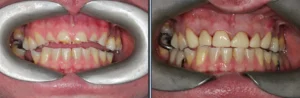
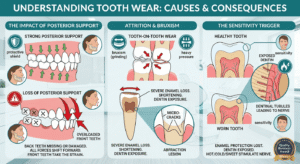
Attrition is the medical term for the mechanical wear caused by direct tooth-to-tooth contact. Every time your top and bottom teeth touch, bite, or slide against each other, a tiny amount of microscopic friction occurs.
Under normal circumstances—such as eating a meal—this wear is minimal and happens slowly over a lifetime. However, when your bite is out of balance or exposed to unnatural forces, attrition accelerates rapidly.
As the outer protective layer of enamel wears down from attrition, the softer inner layer of your tooth (dentin) becomes exposed. Dentin wears down up to seven times faster than enamel and contains tiny nerve tubes, which explains why teeth suddenly become sensitive to hot, cold, or sweet foods once enamel is lost.
2. Bruxism: Night-Time Grinding and Clenching
If attrition is the friction, bruxism is the engine driving it at high speed.
Bruxism is the subconscious clenching or grinding of your teeth, which most commonly happens while you sleep. When you sleep, your brain loses its natural safety reflex that stops your muscles from biting too hard. During episodes of nocturnal bruxism, your jaw muscles can generate hundreds of pounds of pressure directly onto your teeth.
In my surgery, I often spot the classic signs of bruxism long before a patient realizes they do it:
- Flattened Edges: Teeth losing their natural ridges and looking straight or blocky.
- Micro-Cracks and Chipping: Small hairline fracture lines running down the front teeth.
- Gumline Notches (Abfraction): V-shaped grooves popping out at the neck of the tooth right at the gumline, caused by the tooth flexing under heavy pressure.
- Jaw & Muscle Stiffness: Waking up with a tight jaw, facial tenderness, or tension headaches around the temples and ears.
3. Loss of Posterior Support: The Missing Piece of the Puzzle
This brings us to one of the most critical—yet most overlooked—reasons teeth wear away: posterior support.
Your back teeth (molars and premolars) are designed with wide surfaces and sturdy roots to act as the ultimate shock absorbers for your jaw. They are built to take 80–90% of your daily chewing workload. Your front teeth, by contrast, are thin and designed only for slicing food.
When back teeth are missing, broken, or heavily worn down, your bite loses its structural foundation (a collapse of posterior support). Without back teeth taking the strain:
- Forces Shift Forward: Your jaw naturally shifts to force your delicate front teeth to do the heavy chewing work meant for molars.
- Accelerated Wear: Front teeth flex, chip, and grind against each other under loads they were never designed to handle.
- The Destructive Cycle: Front restorations (like fillings or veneers) begin to repeatedly pop off or chip because the underlying bite forces are simply too heavy.
How We Stop the Wear and Protect Your Smile
The good news is that worn teeth can be stabilized, protected, and restored. Treatment is never just about fixing the front teeth—it’s about addressing the root cause:
- Restoring Posterior Support: Replacing or rebuilding compromised back teeth with durable Zirconia crowns, onlays, or dental implants to take the pressure off your front teeth.
- Custom Night Guards (Splints): Crafting a bespoke appliance (like a Tanner or Michigan splint) to wear at night. This absorbs grinding forces, relaxes your jaw joint (TMJ), and physically blocks your teeth from wearing each other down.
- Biomimetic Restoration: Rebuilding lost tooth structure conservative, highly bonded materials that mimic natural tooth flex and strength.
Worried About Teeth Wear?
If you’ve noticed your teeth looking shorter, thinner, or more sensitive, catching it early is the best way to prevent extensive damage.
Call our friendly team at Middlewich Street Dental Practice on 01270 584776 or book a routine assessment with Dr. Scott Hall to check your bite and protect your smile for the future.