
It is one of the most common complaints I hear in my surgery at Middlewich Street Dental Practice. A patient will sit down for their routine check-up, take a sip of cold water, and wince. “Dr. Hall, why are my teeth suddenly so sensitive? It started with cold drinks, but now even breathing in cold air or brushing gives me a sharp, shooting pain.”
Tooth sensitivity—what we call dentine hypersensitivity—is rarely just a random occurrence. It is your mouth’s alarm system telling you that the protective outer barrier of your teeth has been compromised.
If you are cringing at hot tea, ice cream, or sweet treats, here is what is actually happening beneath the surface and why your teeth have lost their natural shield.
1. Exposed Dentine: The Core Cause of the Zing
To understand tooth sensitivity, it helps to understand how a tooth is built.
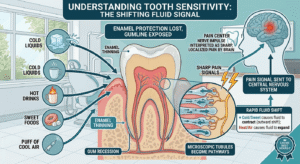
The crown of your tooth is covered by enamel, the hardest substance in the human body. Underneath enamel lies dentine, a softer, yellowish tissue filled with microscopic channels called dentinal tubules. These tiny fluid-filled tubes lead directly to the pulp—the nerve center inside your tooth.
When your enamel thins out or your gums recede, these dentinal tubules become exposed to the outside world. Cold liquids, hot drinks, sweet foods, or even a puff of cool air cause the fluid inside these tubes to shift rapidly, directly triggering the nerve endings and sending a sharp pain signal to your brain.
2. Enamel Loss: Stripping Away Your Tooth’s Armor
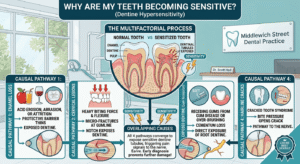
So, how does that protective layer of enamel disappear in the first place? Enamel loss usually happens through three main pathways:
- Acid Erosion: Regularly consuming acidic foods and drinks (like citrus, fruit teas, fizzy drinks, or wine) or suffering from acid reflux (GERD) chemically dissolves enamel minerals over time.
- Toothbrush Abrasion: Brushing too hard, using a hard-bristled toothbrush, or scrubbing horizontally sweeps away enamel—especially near the gumline where it is thinnest.
- Attrition & Grinding: Subconscious clenching or grinding (bruxism) creates heavy tooth-on-tooth friction, physically wearing away the enamel on the chewing surfaces of your back teeth and the biting edges of your front teeth.
3. Cervical Lesions (NCCLs): Notches at the Gumline
If your sensitivity is localized right where your tooth meets your gum, you might feel a distinct notch or hard groove with your tongue or toothbrush. Known as Non-Carious Cervical Lesions (NCCLs) or abfraction lesions, these grooves occur when heavy biting and grinding forces cause your tooth structure to flex.
This continuous flexing causes micro-crystals of enamel to snap off at the narrow neck of the tooth right at the gumline. Because the enamel layer is already naturally very thin at the cervical margin, these notches quickly expose the underlying dentine, creating localized, intense sensitivity to touch and cold.
4. Hairline Cracks: The Hidden Pathway to the Nerve
Sometimes sensitivity isn’t caused by gradual surface wear, but by structural damage. Hairline cracks in teeth—often called Cracked Tooth Syndrome—are extremely common, particularly in teeth with large, old silver fillings or in patients who grind their teeth.
When you bite down on a cracked tooth, the crack flexes open slightly. This movement allows cold fluids, sugars, and bacteria to seep directly into the crack toward the internal dentine and nerve.
- The Tell-Tale Sign: If you experience sharp pain specifically when you release your bite while chewing, or if a specific tooth reacts violently to cold, a hairline crack is very likely the culprit.
How We Stop Tooth Sensitivity and Protect Your Smile
Treatment always begins with finding the exact cause of your enamel loss or exposed dentine. Simply slapping on a desensitizing toothpaste isn’t always enough if underlying biting forces or cracks are ignored:
- Desensitizing & Fluoride Varnish Treatments: For mild enamel wear, professional-grade varnishes applied in the surgery seal off exposed dentinal tubules to block pain signals instantly.
- Custom Night Guards (Splints): If grinding, flexure, or cervical notches are causing your sensitivity, a custom appliance (like a Tanner or Michigan splint) stops the tooth flexure and protects your enamel from further loss.
- Composite Bonding: For deeper cervical grooves or worn areas, tooth-coloured resin can be bonded directly over the exposed dentine to physically insulate the nerve and restore tooth shape.
- Cuspal Protection (Crowns/Onlays): If a hairline crack is causing deep sensitivity, placing a full-coverage crown acts like a hoop around a barrel, holding the crack together and stopping it from flexing when you chew.
Struggling with Sensitive Teeth?
You don’t have to put up with sharp pain every time you enjoy a cold drink or hot meal. Finding the cause early prevents further enamel loss and saves your teeth from more complex problems later on.
Call our friendly team at Middlewich Street Dental Practice on 01270 584776 or BOOK ONLINE to book a consultation with Dr. Scott Hall and get to the root of your sensitivity.