
It is a conversation I have almost daily with patients at Middlewich Street Dental Practice. Often, after we’ve identified grooves near the gumline or pinpointed the root cause of persistent sensitivity, the patient looks at me with a mix of concern and frustration and asks: “Dr. Hall, now that my teeth have started wearing down, is it downhill from here? Can tooth wear actually be stopped, or am I bound to lose more tooth structure?”
My answer is always reassuring: Yes, tooth wear can absolutely be managed, controlled, and slowed down to a natural, negligible rate.
However, because tooth wear is rarely caused by just one factor, stopping it isn’t as simple as swapping your toothpaste. It requires a targeted, comprehensive strategy designed to eliminate the underlying physical and chemical forces eroding your enamel.
Here is how we halt progressive tooth wear and safeguard your smile for the future.
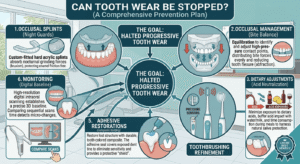
1. Protecting Against Night-Time Forces: Occlusal Splints
If your tooth wear is driven by bruxism (unconscious grinding or clenching during sleep), your teeth are subjected to massive, unnatural forces for hours at a time. This friction flattens biting edges, fractures enamel at the gumline, and strains jaw joints.
The most effective line of defense is a custom-made occlusal splint (such as a Tanner or Michigan splint). Worn at night, this clear, precision-fitted appliance acts as a physical barrier. Instead of your upper and lower teeth grinding against each other, the hard acrylic splint takes the brunt of the force, distributing bite pressure evenly and allowing your jaw muscles to relax.
2. Occlusal Management: Balancing Your Bite
Sometimes tooth wear occurs because your bite is uneven, placing excessive pressure on a few individual teeth. This is where occlusal management comes in.
By carefully evaluating how your teeth meet and slide against one another, we can identify high-pressure contact points. In some cases, subtle adjustments to the biting surfaces (equilbration) or restoring missing back teeth helps distribute heavy chewing forces across your entire arch. Restoring posterior support prevents your front teeth from taking a beating and flexing at the gumline.
3. Neutralizing Acid: Smart Dietary Adjustments
When chemical erosion is part of the equation, enamel softens, making it vastly more vulnerable to mechanical friction. You don’t necessarily have to eliminate every enjoyment from your diet, but small tactical changes make a huge difference:
- Identify Hidden Acids: Fizzy waters, fruit teas, citrus fruits, wine, and cider are frequent culprits.
- Buffer Acid Exposure: Rinse your mouth with plain water or drink a glass of milk after acidic food or drink to accelerate neutralization.
- Timing Matters: Avoid sipping acidic drinks slowly over hours; keep them to meal times when saliva flow is naturally higher to protect your teeth.
4. Refining Your Toothbrushing Technique
Mechanical abrasion from aggressive brushing can sweep away enamel that has been softened by acids or weakened by tooth flexure. To halt brushing-related wear:
- Switch to Ultra-Soft Bristles: Hard or medium bristles act like sandpaper over time. Electric toothbrushes with built-in pressure sensors are ideal for keeping force in check.
- Adopt the 30-Minute Rule: Never brush immediately after eating or drinking anything acidic. Wait at least 30 to 45 minutes for your saliva to re-mineralize and re-harden your enamel.
- Modify Your Motion: Avoid harsh, horizontal saw-like scrubbing. Use gentle, circular motions angled toward the gumline.
5. Restoring and Sealing: Adhesive Restorations
When wear has created deep cervical notches or significantly thinned outer enamel, leaving the underlying dentine exposed, we can step in with adhesive restorations.
Using advanced composite bonding techniques, we can build back lost tooth structure without removing any remaining healthy enamel. These tooth-coloured resin restorations act as a protective “shield,” covering exposed dentine to eliminate sensitivity and restore the natural shape of the tooth. When paired with proper bite management, modern bonding offers a durable, aesthetic defense.
6. The Key to Long-Term Success: Digital Monitoring
Tooth wear happens gradually, which makes it hard to notice in the mirror month to month. That’s why monitoring is one of the most vital tools in our preventive toolkit.
During your routine assessments, we use high-resolution intraoral scanning and clinical photography to create a digital baseline of your mouth. By comparing 3D scans over time, we can track micro-changes in your tooth height and surface contour down to fractions of a millimeter.
If the 3D scans show zero progression year after year, we know our protective plan is working perfectly. If we detect subtle new wear, we can intervene early before significant damage occurs.
Concerned About Wearing Teeth?
Tooth wear doesn’t have to compromise your smile or comfort. With early diagnosis and a tailored prevention plan, we can protect your natural teeth for a lifetime.
Call our team at Middlewich Street Dental Practice on 01270 584776 or BOOK ONLINE to schedule a comprehensive assessment with Dr. Scott Hall.