
By Dr. Scott Hall | Middlewich Street Dental Practice, Crewe
Have you ever found yourself back in the dental chair with a chipped filling or a tooth that has cracked around an old silver or composite restoration?
It’s one of the most frustrating experiences in dentistry—for both the patient and the dentist. You brush, you floss, you go for your regular checkups, yet every few years, that same tooth seems to need fixing again.
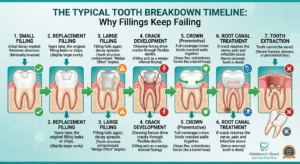
Last week I saw a new patient who’d had the same tooth filled four times in twelve years. They assumed they just had ‘bad teeth’.
So, why does this happen? Is it just bad luck, or is there a deeper physical reason why conventional fillings keep breaking?
The short answer comes down to physics, mechanical stress, and engineering. To understand why fillings fail, we have to look at how teeth work naturally—a philosophy known as Biomimetic Dentistry.
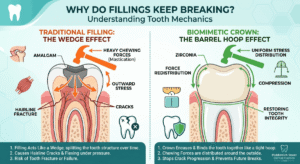
1. The “Wedge Effect”: Why Traditional Fillings Can Cause Cracks
To understand why fillings break, think of a piece of wood. If you drive a steel wedge into a log and hit it with a hammer, the wood splits along its natural grain lines.
Traditional dental fillings often act like that metal wedge inside your tooth:
- Old Amalgam (Silver) Fillings: Amalgam does not bond directly to the tooth. Instead, it is wedged into a mechanical cavity cut into the enamel. Over years of chewing, temperature changes cause metal to expand and contract at a different rate than your natural tooth. This constant expansion creates subtle hairline cracks in the surrounding tooth structure.
- Large Composite Fillings: While composite resin bonds to the tooth, if a filling is too large or placed in a high-stress area, it cannot absorb heavy chewing forces uniformly.
Every time you chew, your jaw exerts hundreds of pounds of force per square inch. Without a complete protective ring around the tooth, the filling acts as a wedge, transferring those massive forces directly into the deep, flexible layers of dentin below. Over time, the tooth simply gives way.
2. Bio-Mechanics & Occlusion: The Power of Your Jaw
Your mouth is an intricate mechanical system. Your jaw joint (TMJ) acts as a powerful hinge, and your chewing muscles can generate immense force.
When your occlusion (how your top and bottom teeth bite together) is uneven, or when you lose back teeth (posterior support), the distribution of weight across your mouth changes drastically:
- Chewing Overload: If you have lost a back molar or favour one side of your mouth due to missing teeth, the remaining teeth absorb double the chewing load.
- Flexing Teeth: Teeth actually flex slightly under extreme pressure. If a tooth has a large cavity or an old filling cut through its central structural ridges, that flexing causes hairline cracks to branch outward toward the root.
If we simply put another standard filling into a flexing, cracked tooth, we are ignoring the underlying forces. It’s only a matter of time before the filling pops out or a section of natural tooth breaks off with it.
3. The Biomimetic Solution: Restoring Teeth the Way Nature Designed Them
Biomimetic Dentistry literally means to copy life.
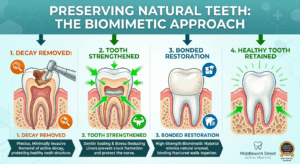
Instead of cutting away large amounts of healthy tooth structure or placing rigid materials that fight against your tooth’s natural mechanics, biomimetic principles aim to rebuild the tooth so it acts, flexes, and distributes stress just like a natural, virgin tooth.
Here is how we approach repairing broken teeth using biomimetic concepts:
A. Sealing & Stress-Reduction
Before restoring a cracked tooth, we carefully analyse the crack lines and stress points. We clear away weak decay and seal the inner dentin layer using advanced adhesive techniques, creating a stress-absorbing foundation that mimics natural dentin.
B. Binding the Tooth Together (Preventative Biomimetic Crowns & Onlays)
When a tooth has multiple cracks or large missing walls, a standard filling will fail. Instead, we use full-coverage Zirconia crowns or biomimetic partial crowns (onlays):
- The “Barrel Hoop” Effect: A crown acts like a tight metal hoop around a wooden barrel. By covering the entire biting surface, it binds all the fractured pieces of the tooth together.
- Force Redistribution: Instead of allowing chewing pressure to push down into the crack like a wedge, a crown redistributes that pressure around the outside of the tooth.
- 90%+ Long-Term Success: Studies consistently show that placing a preventative crown on a structurally compromised tooth before severe pain or nerve damage sets in yields a 90%+ long-term success rate.
C. Balancing Your Bite
We look at the big picture—your entire bite. By ensuring your chewing forces are balanced across all your back teeth, we take the stress off individual high-risk teeth, protecting both your natural enamel and your new dental work.
Stop the Cycle of Repeated Dental Work
If you have a tooth that feels sensitive to chewing, has visible dark hairline cracks, or has lost the same filling multiple times, simply replacing the filling is often a temporary patch.
By taking a biomimetic approach—understanding how your jaw functions, preserving your natural tooth structure, and using high-strength Zirconia restorations to bind cracked teeth together—we can stop the cycle of broken fillings and preserve your natural smile for decades.
Final though – Every time a filling is replaced, the question shouldn’t be “What material shall we use?” It should be “Why did it fail in the first place?
Have a Tooth That Keeps Chipping or Breaking?
At Middlewich Street Dental Practice in Crewe, Dr. Scott Hall and our award-winning team concentrate on structural tooth preservation and long-term restorative care.
To book a routine examination or discuss options for a broken tooth, contact our friendly reception team today on 01270 584776 or visit us at 50-52 Middlewich Street, Crewe, CW1 4DA.