
A patient sat in my chair recently, looked at the intraoral photo of their upper molar on the screen, and asked me directly: “Scott, why do my teeth keep cracking?”
It’s a question I hear almost every day at Middlewich Street Dental. Many patients are surprised to learn that a tooth can crack even if they haven’t been chewing on hard boiled sweets or ice. Tooth enamel is the hardest substance in the human body, yet structural cracks are one of the most common issues we diagnose and treat in modern practice.
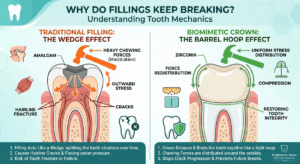
The Real Reasons Teeth Crack
To understand why a tooth cracks, I often explain it to my patients using a couple of simple analogies:
- The “Car Windscreen” Effect: A hairline crack in a tooth behaves much like a tiny stone chip on a car windscreen. It might sit there completely dormant and painless for months or even years. However, under the relentless, daily pressure of chewing, that minor flaw slowly spreads until—without warning—a piece breaks off or the tooth splits.
- The “Internal Wedge” Effect: One of the biggest culprits behind cracked teeth is old, traditional fillings. When a large filling sits inside a tooth, every bite exerts outward pressure. It acts just like a wedge driven into a piece of wood, gradually forcing the surrounding natural tooth structure apart until hairline fractures form.
- Night-Time Clenching and Grinding (Bruxism): Many of us store our daily stress in our jaws while we sleep. Unconscious clenching or grinding subjects your teeth to immense, repetitive forces—far beyond what they were designed to endure during normal eating.
- General Wear and Ageing: Just like any natural material subjected to millions of chewing cycles over a lifetime, enamel gradually loses flexibility and becomes more prone to fatigue fractures.
How Custom Night Guards Protect Your Teeth
Because so much structural damage happens while you sleep, one of our primary lines of defense against cracking is a custom-made night bite guard.
Think of a night guard as a protective shock absorber for your smile:
- Absorbing Heavy Forces: A custom-fitted guard cushions your jaw joint and distributes biting pressure evenly across your entire arch, preventing concentrated forces on vulnerable back molars.
- Preventing Crack Propagation: If you already have hairline cracks or existing dental work, wearing a guard at night stops heavy grinding from forcing those cracks deeper or causing sudden fractures.
- Tailored for Comfort: Unlike bulky, off-the-shelf options from a pharmacy, custom night guards are crafted using precise 3D intraoral scans of your mouth, ensuring a secure, slim, and comfortable fit that protects your enamel without interfering with your sleep.
Why Biomimetic Dentistry Matters
In traditional dentistry, the go-to solution for a badly cracked or broken tooth was often to trim the tooth down heavily into a peg and fit a full coverage crown, or to place another deep filling. However, as we discussed above, placing another deep “place-and-pack” filling often worsens the internal wedge effect!
This is where Biomimetic Dentistry changes everything.
“Biomimetic” literally means to mimic nature. The philosophy behind biomimetic dentistry is simple: preserve as much of your natural, healthy tooth structure as possible and restore the tooth so it behaves, flexes, and functions just like a natural, unbroken tooth.
Instead of aggressively drilling away sound enamel, we use advanced adhesive materials, dental ceramics (like Zirconia), and fiber-reinforced techniques. By bonding custom restorations directly to the healthy tooth, we effectively “wrap” or encase the cracked areas—acting like a steel hoop around a wooden barrel—to bind the tooth walls together, neutralize that damaging wedge effect, and pair them with a night guard for ultimate long-term protection.
What Should You Do If You Suspect a Cracked Tooth?
The trickiest thing about cracked teeth is that they often don’t hurt until the crack reaches the nerve or causes a major fracture.
If you ever experience a sharp, momentary pain when biting down on certain foods, notice soreness in your jaw when you wake up, or have sensitivity to hot and cold that comes and goes, it’s worth having it checked. Catching a crack early—before symptoms start—allows us to preserve the tooth conservatively, avoiding the need for root canal treatments or extractions down the line.
If you’re concerned about teeth grinding or suspect you might have a cracked tooth, feel free to mention it at your next visit. We can take high-definition intraoral photos so you can see exactly what I see!
— Dr Scott Hall