
By Dr. Scott Hall | Middlewich Street Dental Practice, Crewe
In my surgery at Middlewich Street Dental Practice, patients often ask me, “Dr. Hall, why do I really need to save this back tooth when no one sees it anyway?”—much like a recent patient who came to see me because her front veneers kept repeatedly chipping, assuming the veneers themselves were just poor quality. The real issue wasn’t the veneers at all, but rather that she had lost the vital back teeth meant to absorb chewing forces and protect her front smile in the first place.
It is a completely understandable question. When most people think about a healthy, beautiful smile, they naturally focus on the teeth right at the front—the ones that show when they laugh or pose for photos.
However, as dentists, when we evaluate the longevity and health of your smile, our attention almost always turns straight to the back of your mouth.
Your back teeth (molars and premolars) form what we call posterior support.
If you are missing back teeth, or if your back teeth are worn down, cracked, or misaligned, the structural stability of your entire mouth is at risk. Today, we’ll explore the mechanical importance of posterior support and why saving those hidden back teeth is actually the secret to protecting your front teeth for life.
One of the most satisfying parts of my job isn’t creating a beautiful smile—it’s seeing that smile still working well years later. That’s why I spend so much time thinking about posterior support before I ever think about the shape or color of front teeth
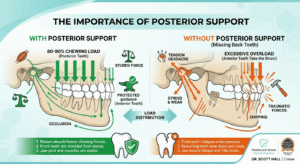
1. The Architecture of Your Bite: Anvil vs. Chisel
To understand posterior support, it helps to look at how different teeth are designed by nature:
- Front Teeth (Anteriors): Your front teeth are designed like thin chisels. Their primary job is cutting and tearing food, as well as guiding your jaw movements. They are not built to absorb heavy vertical crushing forces.
- Back Teeth (Posteriors): Your molars are wide, flat, and anchored by multiple thick roots. They act like sturdy anvils, engineered specifically to withstand hundreds of pounds of daily chewing pressure.
When you have full posterior support, your back teeth absorb up to 80–90% of the chewing load, acting as shock absorbers that shield your delicate front teeth from excessive stress.
2. What Happens When You Lose Posterior Support?
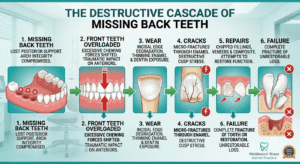
Whether due to tooth extractions, severe wear, or untreated decay, losing back teeth creates a domino effect throughout your mouth—a concept known in dentistry as anterior hyperfunction or bite collapse.
When back teeth are missing or broken down, your bite shifts:
A. Front Teeth Take the Brunt of the Force
Without back molars to stop your jaw from over-closing, your front teeth are forced to act as the primary chewing surface. Because they aren’t designed for this level of stress, you may notice:
- Accelerated wearing down, flattening, or thinning of your front teeth
- Chipping, cracking, or breaking of front composite restorations or veneers
- Front teeth gradually splaying or fanning outward over time
B. Increased Load on Remaining Fillings & Crowns
If you only have a few back teeth left, those remaining teeth have to do double (or triple) the work. As we explored in our post on Why Fillings Keep Breaking, overloading a single tooth drives chewing forces deep into old fillings, accelerating hairline cracks, crown failures, and tooth fractures.
C. Strain on the Jaw Joint (TMJ)
Your back teeth set the height and stability of your bite (your vertical dimension). Losing that structural support forces your jaw joint (TMJ) and masticatory muscles to compensate, which can lead to jaw stiffness, joint clicking, tension headaches, and facial muscle fatigue.
3. The Biomimetic Solution: Restoring Balance and Protecting Your Bite
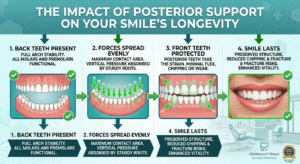
At Middlewich Street Dental Practice, our goal is never to just fix one isolated tooth—it is to restore balance to your entire chewing mechanism.
By applying biomimetic and bio-mechanical principles, we aim to recreate solid posterior support so your entire smile functions harmoniously:
- Replacing Missing Back Teeth: Restoring missing molars—whether through dental implants, fixed bridgework, or well-fitted partial dentures—instantly takes the destructive pressure off your front teeth.
- Reinforcing Damaged Molars: If your back teeth are cracked or heavily filled, placing preventative Zirconia crowns or biomimetic onlays binds those teeth together, restoring their ability to handle heavy chewing loads without splitting.
- Equalizing Occlusion (Your Bite): We evaluate how your top and bottom teeth meet to ensure chewing forces are distributed evenly across all available teeth, protecting both natural enamel and dental restorations.
Protect the Foundation of Your Smile
Fixing a chipped front tooth without addressing a lack of back teeth is like repainting a house with a compromised foundation—it is only a matter of time before the structural issues show through again.
So the next time you ask why we want to save a tooth that no one can see, remember: those back teeth are quietly doing the heavy lifting to keep your front smile intact.
Final thought – Many people invest in whitening, bonding or veneers to improve their smile. These treatments can be excellent—but if the back teeth aren’t providing proper support, even beautifully designed restorations may be placed under unnecessary stress
Concerned About Missing Back Teeth or an Uneven Bite?
If you have missing molars, worn front teeth, or difficulty chewing comfortably, Dr. Scott Hall and the team at Middlewich Street Dental Practice are here to help you rebuild a balanced, long-lasting smile.
To schedule a comprehensive examination, call our Crewe reception team today on 01270 584776, BOOK ONLINE or visit us at 50-52 Middlewich Street, Crewe, CW1 4DA.