
Written by Dr. Scott Hall
In my day-to-day practice at Middlewich Street Dental Practice, patients frequently ask me: “Dr. Hall, if a back tooth fails and needs to come out, why does it really matter if I replace it? You can’t see it when I smile, and I can still chew fine on the other side.”
It is a completely understandable question. When a tooth toward the back of the mouth is lost, it’s easy to view it as out of sight, out of mind. However, what many people don’t realise is that your back teeth (your molars and premolars) do far more than just chew food. They form the foundational pillars of your entire oral health, a crucial concept in dentistry known as posterior support.
When posterior support is lost, the delicate balance of your bite collapses, triggering a domino effect that can damage your remaining teeth, alter your facial appearance, and even cause persistent jaw pain.
Here is why your bite mechanics matter—and why replacing missing back teeth with dental implants restores balance and protects your natural teeth for the long term.
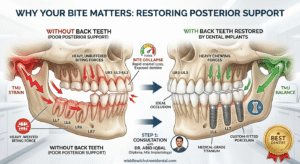
What Happens When You Lose “Posterior Support”?
Your bite is a complex mechanical system. Your back teeth are custom-built by nature to bear heavy biting forces—handling hundreds of pounds of pressure per square inch. Your front teeth, by contrast, are designed only for shearing and cutting.
When you lose molars or premolars without replacing them, those massive chewing forces don’t disappear. Instead, they get redistributed to your remaining front teeth. This leads to a cascade of mechanical issues:
- Occlusal Overload & Front Tooth Wear: Front teeth are not built for heavy grinding. Under excessive pressure, they begin to wear down rapidly, chip, fan outward, or flex near the gumline (causing cervical abfraction notches).
- Tooth Drift & Bite Collapse: Teeth naturally want to touch one another. When a back tooth is missing, adjacent teeth tip sideways into the empty space, and opposing teeth over-erupt. This fundamentally alters how your upper and lower jaws meet.
- Jaw Joint (TMJ) Strain: An uneven bite forces your jaw joints and facial muscles to work in unnatural positions, frequently leading to jaw clicking, muscle fatigue, and chronic tension headaches.
How Dental Implants Restore the Mechanics of Your Bite
While removable dentures or traditional bridges can fill a gap, dental implants are the gold standard for restoring genuine posterior support.
Because a dental implant is made of biocompatible titanium, it fuses directly with your jawbone (a process called osseointegration). This allows the implant to act exactly like a natural, heavy-duty tooth root.
By replacing missing back teeth with dental implants, we achieve three vital goals:
- Absorb Heavy Biting Forces: The implant takes the brunt of chewing pressure, immediately relieving your front teeth from destructive overload.
- Prevent Bone Shrinkage: Implants stimulate the underlying jawbone, preventing the natural bone loss that occurs after tooth extraction and maintaining your natural facial structure.
- Protect Healthy Adjacent Teeth: Unlike traditional dental bridges, implants require zero grinding down of surrounding healthy teeth.
Expert Implantology Care Led by Dr. Abid Iqbal
Because restoring posterior support is as much about complex engineering and precision bite management as it is about surgery, advanced expertise is essential for a predictable, long-lasting result.
At Middlewich Street Dental Practice, our dedicated implant service is led by Dr. Abid Iqbal. Dr. Iqbal holds a prestigious Diploma in Implantology and is completing his Master of Science (MSc) in Implantology—representing the highest level of university-based postgraduate training in the field.
Combining advanced digital 3D bite planning, computer-guided surgery, and bone augmentation, Dr. Iqbal meticulously designs each implant placement to ensure your new teeth handle biting forces perfectly. Whether you require a single molar replacement, a multi-tooth implant bridge, or full-arch reconstruction, your bite is restored with absolute scientific precision.
Reclaim Your Bite and Protect Your Smile
If you are missing back teeth or noticing that your front teeth are starting to wear down or shift, your bite may be telling you that it has lost its posterior support. Replacing missing back teeth early is the single best investment you can make to protect the rest of your natural teeth for a lifetime.
To discuss your options or schedule an implant consultation with Dr. Abid Iqbal, contact our team at Middlewich Street Dental Practice on 01270 584776. or BOOK ONLINE