
Written by Dr. Scott Hall
In my surgery at Middlewich Street Dental Practice, patients are often surprised when I spot a hairline crack around an old silver filling. The most common response I get is: “Dr. Hall, it doesn’t hurt at all! Can we avoid a root canal, and do I really need a crown right now?”
It is a fair question. Why fix something that isn’t causing you pain today?
The short answer is: Yes, you can often avoid a root canal—if we catch and protect the cracked tooth early.
Here is what is happening inside a cracked tooth, why a standard filling usually won’t work, and how a preventative crown protects your natural smile.
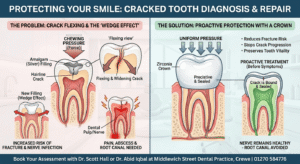
Why Cracked Teeth Don’t Always Hurt (Yet)
Your tooth has a hard outer layer protecting a delicate nerve inside.
When a hairline crack forms around an old filling, it usually starts on the outside. At this early stage, your nerve is healthy and completely symptom-free.
However, every time you chew, your jaw exerts heavy pressure. This causes the crack to flex slightly. Over time, that constant flexing forces the crack deeper toward the nerve.
- If we act early: We can place a full-coverage crown over the tooth. The crown acts like a strong metal or ceramic band, holding the tooth together so it cannot flex. This seals the crack, protects the nerve, and avoids the need for a root canal entirely. Proactive crowns placed before pain starts have about a 90% long-term success rate.
- If we wait for pain: Once a crack reaches the nerve, bacteria enter and cause an infection or abscess. At that stage, your only options are a root canal or taking the tooth out.
The “Wedge Effect”: Why Another Filling Won’t Fix It
When a tooth already has a large filling and hairline cracks, adding another composite filling is like putting a wedge inside a splitting piece of wood.
Standard fillings sit inside the middle of your tooth. Under heavy chewing forces, a central filling actually pushes outward against weakened tooth walls. This wedging action forces the cracks to spread, risking a severe fracture below the gumline where the tooth can no longer be saved.
When Does a Tooth Really Need a Crown?
A crown isn’t just a cosmetic fix—it is structural protection. Instead of sitting inside the tooth like a filling, a crown fits entirely over the outside, binding everything together.
We generally recommend a crown if:
- You have hairline cracks on a back tooth that takes heavy chewing pressure.
- More than half of your natural tooth is missing due to old, large fillings or decay.
- A corner (cusp) of the tooth has broken off.
- The tooth has had a root canal, making it brittle and prone to snapping.
The Golden Window: Don’t Wait for Pain
The most important thing to remember is that pain is a late warning sign in dentistry.
By the time a cracked tooth hurts when you bite or becomes sensitive to hot and cold, the crack has often reached the nerve. Treating a cracked tooth proactively while it still feels fine is the safest, most predictable way to save your natural tooth for the long run.
Have Questions About an Old Filling or Cracked Tooth?
If you’ve been told you have a cracked tooth or want us to check an old filling, we are always here to help.
To book a review with me, Dr. Scott Hall, or to discuss our digital restorative care with Dr. Abid Iqbal, contact our friendly team at Middlewich Street Dental Practice in Crewe on 01270 584776. or BOOK ONLINE