
Today at Middlewich Street Dental in Crewe, a patient asked me a question that I hear quite often: “Why did my friend’s crown last over 25 years, but the one I had placed at another clinic failed after just 5?”
It is a completely fair question. Patients naturally assume a crown is a single, indestructible piece of porcelain that should last a lifetime. But the reality is that a crown is only ever as strong as the tooth underneath it and the precise technique used to secure it.
The difference between a crown that lasts decades and one that fails early comes down to two very different clinical philosophies: traditional aggressive dentistry versus modern Biomimetic principles using Vertiprep techniques.
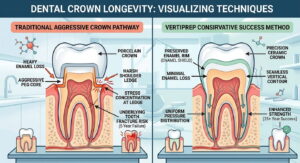
The Traditional Approach: The “Peg and Thimble”
Traditionally, preparing a tooth for a full crown meant heavily grinding it down into a small, peg-like shape with a harsh horizontal ledge (a shoulder or chamfer margin) around the gumline.
When a patient in Cheshire comes to us with a tooth that already has a large old filling or recurrent decay, shaving away even more healthy outer enamel to fit a conventional crown leaves very little natural structure behind.
- The Wedge Effect: Old amalgam or composite fillings sit deep inside the tooth. Without enough natural wall strength, daily chewing forces act like a wedge, flexing the remaining tooth structure from the inside out.
- The Hidden Micro-Leakage: Traditional cements break down over time under constant chewing pressure. Micro-gaps form under the crown, allowing bacteria to seep in unnoticed until the tooth decays from within.
When a traditional crown fails after 5 years, it is rarely because the porcelain broke—it is usually because the remaining tooth underneath fractured or decayed away.
My Biomimetic Approach: Vertiprep & Enamel Preservation in Crewe
Biomimetic dentistry means “to copy life.” At Middlewich Street Dental, our goal is to respect and preserve natural tooth tissue. Instead of aggressive shoulder preparations, I utilize a Vertiprep (Vertical Preparation) workflow. This gives you the full, protective strength of a complete crown while preserving as much precious natural tooth structure as possible.
Here is why this combination can protect your tooth for 25+ years:
1. Preserving Your Natural Enamel
Enamel is nature’s ultimate shield and the strongest substrate we can bond to. A Vertiprep allows me to gently prepare the tooth vertically without cutting away excessive healthy enamel at the gumline. Retaining this enamel rim maintains the tooth’s natural strength and flex resistance.
2. Eliminating the “Step” & Creating a Ferrule
Traditional preps cut a horizontal “ledge” into the tooth, which creates a point of stress. A vertical prep allows the crown to hug the natural contours of the tooth seamlessly, distributing chewing forces evenly along the root.
3. Advanced Adhesive Bonding Protocols
Instead of relying on basic cements that wash out over time, I use high-strength adhesive bonding protocols. The crown and remaining tooth structure are fused together, sealing out bacteria and completely reinforcing weak walls against the wedge effect.
The Windscreen Analogy: Why Acting Early Matters
I often tell my patients in Crewe to think of a weakened or cracked tooth like a crack in a car windscreen.
A small crack can sit on your windscreen for months without causing a problem. But every time you hit a bump in the road, that crack flexes. If you ignore it, it will eventually spread right across the glass, resulting in sudden, catastrophic failure where the whole windscreen shatters.
In dentistry, waiting until a heavily filled or cracked tooth starts hurting usually means the crack has already traveled down into the nerve or root. By taking a biomimetic approach early—binding the tooth together with a Vertiprep crown before catastrophic failure occurs—we stop that crack in its tracks and protect your natural smile for decades to come.
Book a Consultation at Middlewich Street Dental
If you have an old filling, a cracked tooth, or are concerned about a failing crown, contact Middlewich Street Dental in Crewe. Dr Scott Hall and our team specialize in advanced, tooth-preserving restorative techniques designed for long-term health.
- Address: 50–52 Middlewich Street, Crewe, Cheshire, CW1 4DT
- Telephone: 01270 584 776
- OR BOOK ONLINE HERE